Every year without exception, I had to give the “you’re not all that” speech to my fifth graders. Usually occurring during the third quarter of the school year (earlier or later depending on the particular group of kids), the speech came out when the behavior had deteriorated to the point that something had to be said; the students were talking back or refusing to follow directions or treating each other unkindly. Because you know you’re going to be all grown up when you get to middle school, can have more choices on the lunch menu and your own locker. The locker whose number you can’t remember as a 6th grader or get jammed into by a 7thgrader. Life can be cruel. Obviously it’s because they haven’t learned we all have a place in the artificial hierarchies where others perceive you belong.
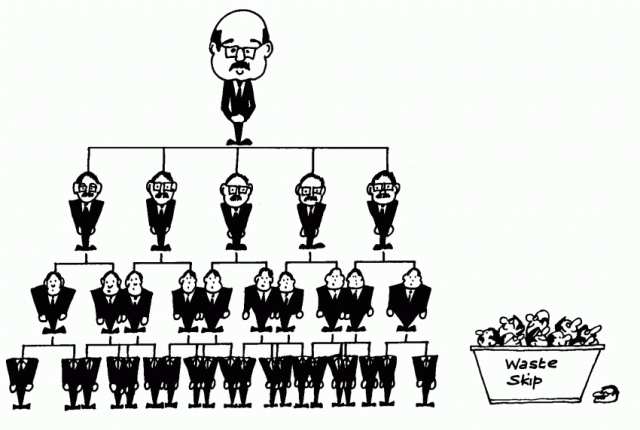
There are so many and for every area of our lives. We know that people who live on the coasts not only set trends nationally but have more clout than those who live in fly-over country and live under rocks. We all know that people in the south are less educated and therefore less progressive. In the world of education, despite the idea that we’re all here for the kids, there are definite hierarchies in place. Superintendents to curriculum people to principals, to assistant principals to teachers to paraeducators, we all know our place. And we know that those who teach high school are more important than those who teach elementary school – in fact we question people, especially men, who choose to stay at the elementary level and not “move up” to high school. After all, just like my 5th graders, we always want to keep moving “up”, not necessarily forward. So, elementary to middle school to high school to higher ed of course.
A bachelor’s degree is no longer enough for teachers, despite the fact that only 32% of people 25 and older have obtained one – it is assumed that teachers will pay their way through obtaining a Masters degree, at least at the K-12 level and the “terminal” degree or PhD (doctorate) are the goal to teach college. Notice I haven’t mentioned experience at all here. You can have a PhD, having never or barely taught at the K-12 level and still teach college. They may never have learned the art of teaching and yet they have the opportunity to teach those at the top level of their discipline. As we all know, knowing content and knowing how to transfer that content to others are two completely different things. But I digress.
Less than 2% of the world’s population has a doctoral degree. That is quite the accomplishment, but the more I hang out with these accomplished folks, I find there is a certain biased group who, like my 5th graders, believe they’re all that and that those who are beneath them in the hierarchy have nothing to contribute. Of course I’m not talking about everyone – I am fortunate enough to call many of these intellectual colleagues my friends, but at the same time I know there are others who judge me and others based on our perceived “lack” of education or where we decide to use our gifts.
Add that to the fact that I obtained my education in the south, chose to teach elementary school in flyover country and I am obviously someone who made the decision to stay at the bottom of the educational ladder. Not that I chose to stay there because I believe that’s where my gifts lie and where I can make the biggest impact, but obviously I wasn’t go getter enough to become one of the 2%. Thirty years of experience in the trenches of my profession may not be enough to be taken seriously. For some, no matter how much I learn on my own, if I can’t show them a piece of paper, my ideas, perceptions, and/or experiences will never be intellectual enough.
Sour grapes? It may sound like that, although that wasn’t my intent. Frustration – perhaps. Like all of us, there are choices I’ve made throughout my life that have led me to where I am today. And I’ve been beyond fortunate to have had the myriad of experiences I’ve had in my academic life/career. Many of those have occurred because of colleagues who have believed in me and have helped me along the way. And I suppose that is what I would like to pass on to my younger students and colleagues. There’s nothing wrong with ambition and wanting to learn more and make yourself better, but no matter where you end up, you have something to contribute just because of who you are and because of the experiences you have had by following your passion. Just as I need to remind myself occasionally, you shouldn’t be curtailed because someone else has placed you within an artificial hierarchy.
 A Music Teacher's Mid-Life Musings