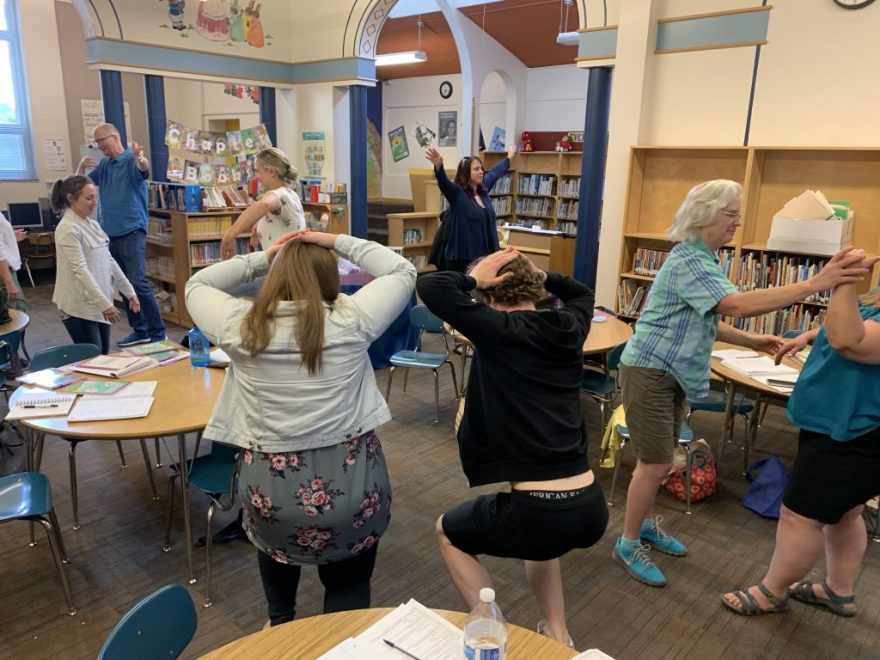
Sometimes attending conference in an exercise in extrovertness. I know that’s not a word, but let’s go with it. After presenting three sessions of my own, I was excited to attend a colleague’s session this morning, a master teacher in First Steps, a method of teaching music to children. It’s something that wasn’t taught when I graduated way back in the dinosaur days and it is a little intimidating. But I thought I would go, knowing full well that this was not going to be a place for introverts, specifically because it was a session on movement in music. You know you can’t teach about movement without DOING movement. In front of other people. People you don’t know. I am however, secure enough in myself that I no longer beat myself up for sitting against the wall or in a corner and watching and taking notes instead of participating.
Now, the session for movement was not just movement, it was movement for elementary aged students (although you could do it with anyone), so participation means you have to let out your inner child. I didn’t let out my inner child when I WAS a child. I wasn’t about it do it now. However, it is a bit entertaining to watch others who have no problem letting their inner child out and flowing everywhere. I absolutely understand we learn by doing, it’s just a challenge for me.
So, here’s what I saw. Adults making circles with their bodies. Circles with their arms, shoulders, and knees. Adults shaking body parts with a tambourine. Adults painting circles in the air with paintbrushes to music. Adults imagining themselves playing twister on the ground or in the air, getting themselves into some crazy position and then attempting to do movement in that position. The movements that are so adorable coming from a 6 year old are something else coming from an adult. Why? Some of the adult movements are just as awkward as a child, but something very important was missing. There were no smiles. There was no laughter or giggling. These people were serious about their play.
This is the thing that always made me crazy about becoming a general music teacher and choosing a methodology or philosophy to follow. Somehow the only way to learn a methodology for children is to act like a child. This is hard when you know longer think like a child. You may understand children, but you are no longer a child. By the way, if you understand children, will you fill me in? But I digress. Yet somehow, instructors think you have to act these things out as an adult child (or childish adult?) in order to understand how to do the activities. These are research based methodologies, research done by adults for adults, and yet when they’re taught, we must act like a child to understand them.
I’m not knocking those people who are so comfortable in their own skin that they’re willing to gyrate to all kinds of music in front of others for the sake of educating children. Shoot, I do it all the time WITH children to model it, but don’t ask me to do it in front of my peers. And I’m not honestly sure of how a clinician/instructor would teach other adults how to do these things without the participants, well, participating. I just can’t be one of those people. I’m grateful that this instructor didn’t try to guilt me into participating with her. I’ve had some who have and then I have this combination of embarrassment melding with really uncomfortable. I actually had a professor who wrote a book about introvert and extrovert musicians, who embarrassed me in front of a grad class by giving me a hard time for not participating in a karaoke activity. Maybe he didn’t learn anything from his own writing? Let it go, Judy.
What I think about when I see this is how well this translates or doesn’t translate to a classroom with real kids. I’ve seen teachers who strictly follow their chosen path and they are extraordinary and others who can imitate in workshops but can’t translate it effectively for kids. Is it because they focused too much on imitating the activity itself and didn’t understand how to apply to the students? I know I had issues when I attended my first Orff certification. Everything worked beautifully when I performed it with 15 other adults pretending to be kids. Not so much when I returned to 30 5th graders in my classroom. No one talked much about expectations, procedures and behavior management because the 15 adults all behaved. And didn’t turn the instruments into weapons. Or dance in provocative ways to make their friends laugh. I could go on.
So again, I go back to the participants I saw today. With no smiles. Maybe they’re not having fun either but they’re rule followers, doing what they think they’re supposed to do. Maybe they think they won’t be taken seriously if they smile or laugh. After all, we’re educators. We’re not supposed to be having fun and risk being taken seriously as educators. Music is already considered fluff by some, and music being fun just hurts our cause, right? Or maybe we just take what we do too seriously.
 A Music Teacher's Mid-Life Musings